




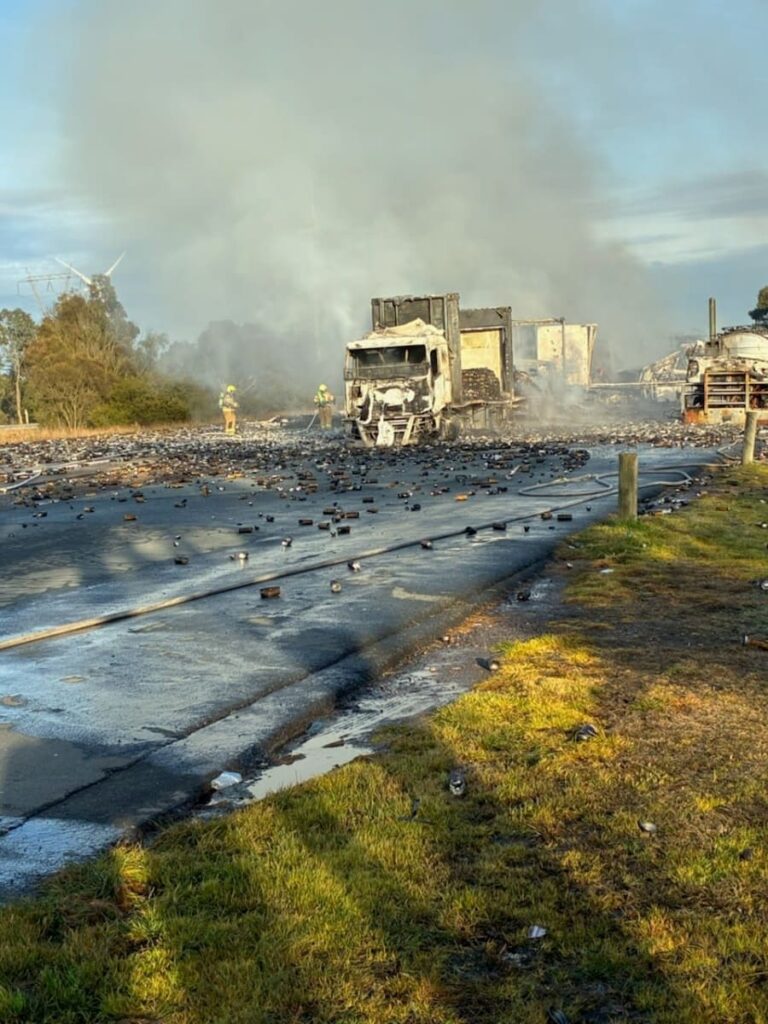
A major crash involving seven semi-trailers near Gunning in NSW’s Southern Tablelands last week was a sobering reminder that serious incidents can occur quickly in heavy vehicle operations.
The Hume Highway was closed in both directions near Breadalbane after two trucks reportedly collided shortly after 5am on 30th June before entering a roadside rest stop and striking five other rigs.
The resulting fire was intensified by the freight being carried. One truck was transporting eight tonnes of butane cans, while other loads included resin, memory foam and alcohol. Four drivers escaped the wreckage, but another driver had not been located as emergency crews responded.
Fire and Rescue NSW deployed seven fire trucks, including two hazardous materials appliances, and up to 40 firefighters. Police, ambulance, Rural Fire Service and traffic management crews were also involved, with a 300-metre exclusion zone established around the site.
Investigations will determine what caused the crash. However, incidents of this scale reinforce why heavy vehicle safety must remain an active operational focus, not simply a compliance exercise.
For transport operators and supply chain partners, that means continually managing the practical risks around fatigue, journey planning, vehicle maintenance, load security, dangerous goods, rest locations, emergency response and safe work practices.
Chain of Responsibility obligations require all parties involved in heavy vehicle transport activities to take reasonable steps to manage safety risks within their control. That responsibility extends beyond the driver and transport operator to the broader businesses that influence how, when and under what conditions freight is moved.
Safety systems, procedures and records remain essential. But the real test is whether controls are effective in day-to-day operations, particularly when unexpected conditions, high-risk loads or multiple vehicles are involved.
This incident is a reminder for every business connected to heavy vehicle transport: accidents do happen, and the work of preventing them needs constant attention.
- From compliance to coaching: how fleets can use driver data to change behaviour
 Most drivers in Teletrac Navman’s survey already receive some form of performance feedback. The more useful question for fleet operators is how that feedback is delivered, and whether data is being used to develop drivers or simply record mistakes. Fleet safety technology can identify events quickly, but a dashboard does not decide what happens next.
 - Thousands of Truck Drivers Gain Life-Saving First Aid SkillsMore than 4,000 truck drivers across Australia have completed the free Truckie First Aid online training program developed by NatRoad and St John Ambulance Australia. The milestone reflects growing industry participation in a program designed to give heavy vehicle drivers practical first aid skills for situations where they may be among the first people to
- Technology adoption works when it is framed as support, not surveillanceTransport operators are deploying more cameras, telematics, fatigue systems and AI-enabled tools than ever before. But the success of those investments will often depend less on the technology itself than on how it is introduced to drivers. That was a clear message from the TruckShowX session featuring WHG Technologies Director of Operations Dylan Hartley, Wettenhalls
- Why a premium driver’s seat is more than a comfort upgradeFor a professional driver, the seat is the workplace. It is where they spend long hours managing traffic, loading docks, customers, road conditions, vehicle controls and tight delivery schedules. Yet when fleets specify a new truck, the driver’s seat can still be treated as a minor option rather than a key safety and productivity decision.
- The New Master Code Starts Load Safety Long Before a Truck ArrivesWhen people think about Chain of Responsibility (CoR), they often think about overloaded trucks, load restraint breaches and weighbridge inspections. The new Master Code of Practice under the Heavy Vehicle National Law (HVNL) takes a much broader view. The Code dedicates seven transport activities to loads, loading and unloading, beginning with the design and packaging