





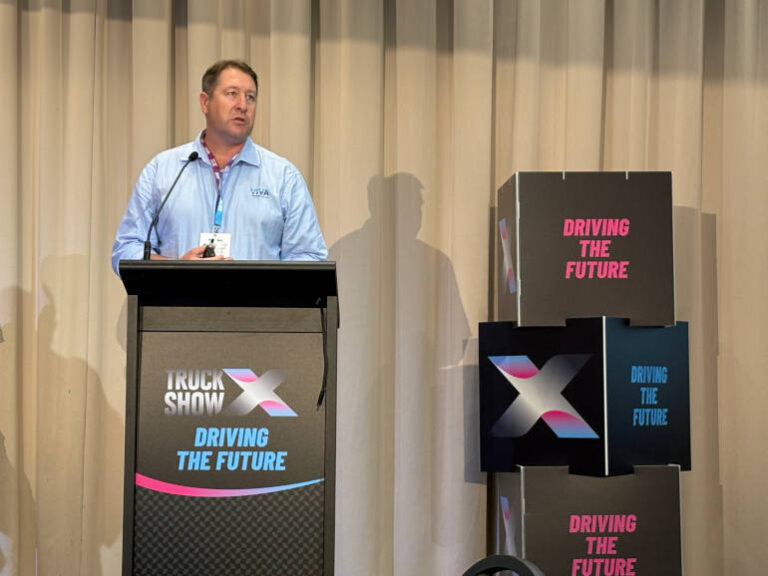
Heavy-vehicle operators do not need to wait for electric or hydrogen trucks to begin reducing emissions, according to Viva Energy Australia Carbon Solutions Manager Robert Cavicchiolo.
Speaking at TruckShowX, Cavicchiolo said hydrotreated vegetable oil—commonly known as HVO or renewable diesel—could provide an immediate emissions-reduction pathway for fleets using existing diesel vehicles, storage tanks and refuelling infrastructure.
Rather than replacing trucks or building new charging and hydrogen facilities, operators can substitute conventional diesel with a compatible renewable fuel.
“It is a nice interim step until we get to the zero-emission technologies of electrification or green hydrogen,” Cavicchiolo said. “You don’t have to change your truck. You don’t have to change your infrastructure. You just have to change your fuel.”

HVO is not traditional biodiesel
Cavicchiolo stressed that renewable diesel should not be confused with conventional biodiesel, which is generally produced as fatty acid methyl ester, or FAME, and blended with mineral diesel.
HVO is a paraffinic diesel that can be used as a drop-in replacement for conventional fuel. It is fully compatible and miscible with mineral diesel, allowing the two fuels to be mixed within existing tanks and distribution systems.
The introduction of Australia’s Paraffinic Diesel Fuel Quality Standard Determination 2025 has also provided a regulatory specification for the fuel.
This gives fleet operators greater confidence that renewable diesel entering the market must meet recognised minimum quality requirements.
Cavicchiolo said the fuel was also recognised within Australian greenhouse emissions reporting frameworks, making it possible for organisations to account for reductions as part of formal decarbonisation programs.
“We’ve got a fuel now that’s approved by the government,” he said. “You can make your carbon emission savings legitimately and under regulated frameworks.”
Change the conversation from fuel price to emissions
The major barrier remains cost, with renewable diesel currently more expensive than conventional fuel.
However, Cavicchiolo argued that operators and customers needed to move beyond treating HVO simply as another fuel purchase.
He said tenders were increasingly asking transport providers to explain how they would reduce their carbon footprint throughout the life of a contract. Renewable diesel could therefore become part of a fleet’s value proposition rather than being assessed only through a cents-per-litre comparison.
“You need to look at this from an emissions perspective,” he said. “What are these fuels and technologies trying to address in terms of emissions, and how do you put some value on those carbon emissions?”
This could involve calculating the emissions associated with moving a tonne of freight and allocating the cost of lower-carbon fuel to individual customers or contracts.
Cavicchiolo said many fleets were already passing on conventional fuel price movements through fuel levies. Adding a separate low-carbon fuel levy without explaining the emissions benefit, however, could discourage adoption.
Instead, operators should demonstrate how renewable diesel helps customers meet supply-chain emissions targets and recover the additional cost through a shared decarbonisation strategy.
Trials can create commercial opportunities
Cleanaway’s experience was highlighted as an example of how a small demonstration could develop into a broader commercial program.
The waste management company began testing renewable diesel in Victoria, including a truck servicing Coles and another operating with the City of Casey.
The fuel was later deployed in Queensland through the container refund network before being introduced into further operations in New South Wales.
Cavicchiolo said these projects showed the importance of involving fuel suppliers, vehicle manufacturers, fleet operators and customers from the beginning.
“There might be commercial risk, technology risk, productivity risk or reliability risk,” he said. “But it is important to get everyone around the table when you are talking about these types of initiatives.”
Demonstrations build confidence within a fleet, but they can also provide evidence for customers evaluating emissions commitments during procurement.
“What started as small trial demonstrations has now opened up bigger business and resulted in more tenders,” Cavicchiolo said.
Operational benefits beyond carbon
Trials conducted with customers had found no noticeable increase in fuel consumption, according to Cavicchiolo.
Testing had also recorded reductions in particulate matter, nitrogen oxides and carbon monoxide emissions from the exhaust.
Because HVO burns more cleanly than conventional diesel, it may also provide benefits for diesel particulate filter regeneration, AdBlue consumption, maintenance requirements and vehicle reliability.
Research was increasingly examining the potential health benefits associated with reducing pollutants around drivers, workers and communities, particularly in enclosed or high-activity operating environments.
“We are starting to look not only at carbon emissions, but at the health benefits of these fuels from the exhaust,” Cavicchiolo said.
Renewable diesel already working across industries
Viva Energy had supplied or supported renewable diesel projects across transport, mining, aviation support, construction, defence and infrastructure.
Examples included a 10-million-litre program with Rio Tinto, renewable diesel used in temporary generators supporting the Australian Formula 1 event, and applications at Western Sydney Airport.
The fuel had also been tested in coal mining equipment, rail applications and defence operations.
Cavicchiolo said the breadth of these projects demonstrated that the principal challenge was no longer whether the fuel could work in diesel equipment.
The bigger questions were availability, scale and how operators valued the emissions reductions.
Transport must compete for renewable fuel supply
Australia currently relies on imported HVO, with significant local production unlikely in the immediate future.
Viva Energy is investigating how its Geelong refinery could progressively process lower-carbon feedstocks, including used cooking oil, tallow and pyrolysis oils, alongside conventional crude oil.
However, Cavicchiolo warned that road transport would be competing with aviation, mining and marine operators for renewable feedstocks and finished fuel.
He said the aviation sector was particularly well organised and was actively advocating for policy support and future supply.
“You are in a race between aviation, mining, marine and transport for these types of fuels,” Cavicchiolo said.
He encouraged the heavy-vehicle industry to engage with government and ensure road transport was represented as policies, incentives and demand measures were developed.
A multi-energy future
Cavicchiolo said the future transport energy network would not be based on one technology.
Viva Energy’s Geelong site already provided a glimpse of that model, bringing together conventional diesel, renewable diesel, hydrogen and high-speed electric charging.
For fleet operators, the transition was likely to involve several overlapping technologies selected according to vehicle duty cycles, infrastructure availability and operational requirements.
Renewable diesel would not replace the need for battery-electric or hydrogen vehicles. Its value was that it could begin reducing emissions while those technologies, vehicles and supporting networks continued to develop.
“Use stepping stones to get to the end game,” Cavicchiolo said.
For fleets facing immediate emissions targets but unable to replace large numbers of vehicles, HVO could be one of the most practical steps available.