





The race to reduce heavy vehicle emissions is often framed around the choice between diesel, battery electric, hydrogen and other alternative fuels.
But a case study presented at TruckShowX showed that fleet sustainability reaches much further than the powertrain.
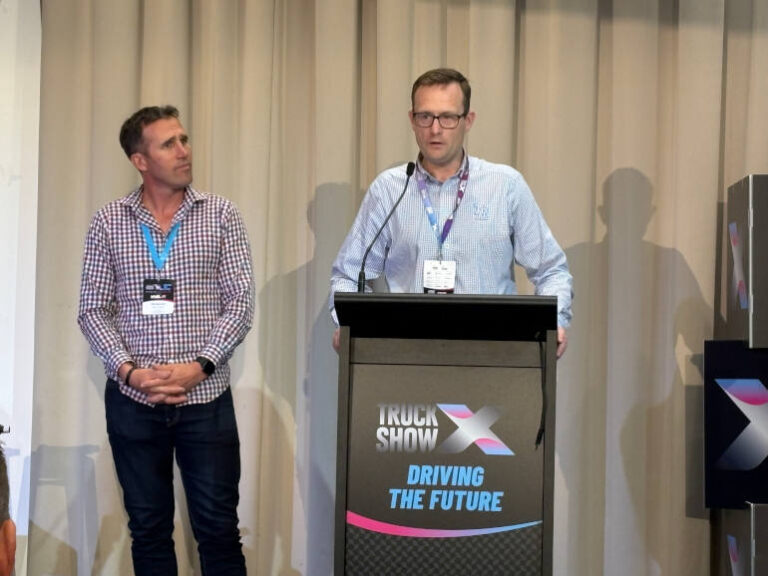
Scott Donnelly, New Energy & Emissions Reduction Lead at TR Group, and Will Samuel, General Manager at Rhino Guard, argued that fleets should also be examining the materials, components, replacement cycles and end-of-life processes across every vehicle.
Their message was simple: a lower-emissions truck should also use lower-emissions parts.

Small components can carry a large footprint
TR Group operates approximately 10,000 trucks and trailers across Australia and New Zealand, including more than 100 low- and zero-emission vehicles.
While much of its emissions reduction work is focused on new powertrain technologies, Donnelly said the company cannot ignore the carbon contained in the wider vehicle supply chain.
“We don’t get to stop just at the cab or the engine,” he said.
Fleets are increasingly being asked by customers, investors and regulators to understand what their vehicles and components are made from, where they were manufactured and what happens to them at the end of their working life.
That scrutiny now extends to components that have traditionally received little attention, including mudguards, plastics and surface coatings.
“What is this product made from? Where does it go end of life?” Donnelly said. “This is why components suddenly matter in conversations they were never part of before.”
An uncomfortable question started the process
Rhino Guard’s recycling program began when a major customer asked what its mudguards were made from and whether they could be recycled.
At the time, damaged or worn guards were generally sent to landfill or, in some cases, burned.
Samuel said the company had to accept responsibility for the product beyond the point of sale.
“We’re the custodian of this product. We’re making it. What do we do about it?” he said.
Rhino established a process under which used guards are returned, cleaned of contaminants such as bitumen and metal fittings, shredded and converted into material that can be used to manufacture new products.
The resulting recycled mudguards have an independently verified carbon footprint 76 per cent lower than guards made through the company’s conventional process.
Carbon measurement demands evidence
Reaching that figure required Rhino to examine around 50 separate data points across its supply chain.
The assessment covered raw materials, manufacturing, electricity, gas, shipping, road freight, product distribution and recycling.
Samuel said the process took roughly two years to gather the necessary information and another year to complete independent verification.
The level of scrutiny was significant. Freight emissions data, for example, had to be supported by shipment records and details of the people who supplied the information.
That reflects the growing pressure on companies to substantiate environmental claims rather than relying on broad sustainability statements.
“Greenwashing is really real, and so you have to be really valid in everything you’re supplying,” Samuel said.
His advice to other businesses was to measure projects that are already producing good results, even when the emissions benefit is not immediately obvious.
“If you’ve got some cool stuff happening in your business, just give it a go,” he said.
Sustainability must survive fleet conditions
Lower embodied carbon alone would not have been enough for TR Group to adopt the recycled guards.
Donnelly said every product must also meet the fleet’s requirements for uptime, cost, durability and supply security.
“Nothing we do works unless it works operationally,” he said.
TR Group replaces about 3.2 per cent of its mudguards each year, meaning it could take approximately 31 years to replace every guard across the fleet.
That long replacement cycle changes the economics of purchasing decisions.
A cheaper component can quickly become more expensive if it fails early, causes downtime, requires additional labour or contributes to tyre damage.
“Fleet economics is a brutal multiplier,” Donnelly said. “That $100 saving in a part can easily turn into $1,000 of cost.”
The recycled guards also use UV additives to resist fading, cracking and brittleness. Rhino displayed examples that had remained in service for close to a decade.
For TR Group, that durability makes the initiative as much a fleet performance case study as an environmental one.
Recycling can also strengthen supply chains
The project has delivered another benefit: reduced dependence on virgin plastic and imported raw materials.
Recent global disruptions have again exposed the risks associated with oil-based plastics, international shipping and long supply chains.
Rhino is now sourcing additional recycled plastic because demand for recycled guards is greater than the supply of returned products.
Samuel said using material already available locally gives the company greater control over manufacturing and reduces its exposure to overseas disruption.
Security of supply has therefore become another argument for circular manufacturing, alongside lower emissions and reduced waste.
Practical innovation can be easy to overlook
The TruckShowX case study challenged the idea that transport innovation must involve an entirely new vehicle or propulsion system.
“Sometimes it’s a lot simpler,” Donnelly said. “Who would have thought that recycled plastics equals carbon reduction equals innovation?”
For large fleets, practical changes to frequently used components can produce meaningful results when applied across thousands of vehicles and over long service lives.
The initiative also shows how sustainability, quality and cost can reinforce each other rather than compete.
The recycled guards lower embodied emissions, divert waste from landfill, improve material security and still meet TR Group’s operational requirements.
“Boring, practical, but it’s effective,” Donnelly said.
Fleets need to examine the whole vehicle
TR Group continues to assess battery electric, hydrogen fuel cell and other lower-emissions technologies according to the task each vehicle must perform.
But Donnelly said changing the drivetrain alone does not create a genuinely low-carbon truck.
“If it’s a low-carbon vehicle, it should be built with low-carbon parts designed for longevity, repair and reuse,” he said. “That’s how the emissions add up, or don’t.”
For fleet managers, the broader lesson is to look beyond fuel and tailpipe emissions.
Tyres, plastics, trailers, replacement parts, maintenance processes, freight movements and end-of-life recovery all contribute to the environmental footprint of a fleet.
The largest gains may still come from changing how a vehicle is powered. But the TR Group and Rhino Guard case study demonstrates that sustainability has many angles—and fleets that examine all of them will be better placed to reduce emissions without sacrificing reliability or whole-of-life performance.