

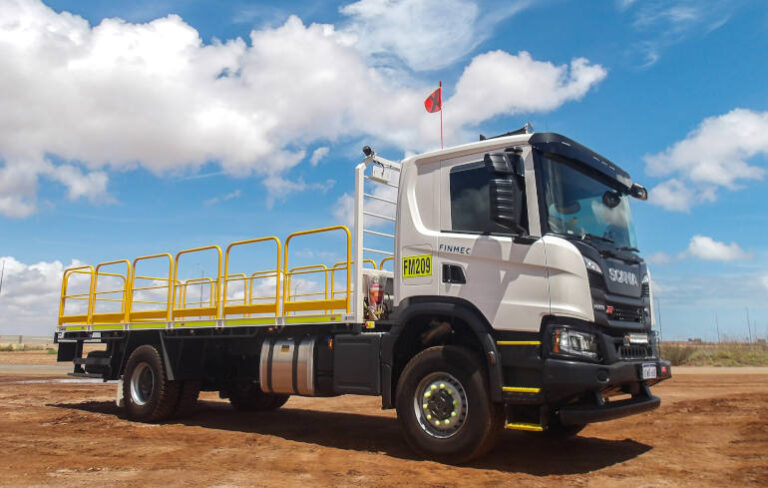
Port Hedland equipment specialist Finmec is expanding its Scania-based rental fleet to support mining, rail and civil operations across Western Australia’s Pilbara region.
The locally owned company operates a mix of 4×4, 6×4 and 8×4 trucks configured for roles including mobile servicing, water cartage, site clean-ups, rail maintenance and workforce transport.
Around 80 per cent of the fleet operates off-road, travelling on gravel access roads between mines, rail infrastructure and port facilities.
Rental fleet fills an operational gap
Finmec was established by Daniel and Jessica Finch in 2007 with a single ute. The Port Hedland business now employs almost 100 people and provides equipment hire, repairs and maintenance across the mining, transport and civil sectors.
The company became an authorised independent Scania dealer in 2016 and moved into equipment rental after identifying demand from operators dealing with breakdowns, short-term projects and gaps in their own fleets.
Daniel Finch said uptime was the central requirement for customers operating in the region.
“An hour of downtime could mean millions in lost production,” he said.
Finmec typically keeps its rental trucks for five to seven years, with maintenance scheduled according to both kilometres and operating hours. This reflects the amount of time mining service vehicles spend running auxiliary equipment while stationary.
Trucks configured for specialist roles
The company’s 6×4 trucks are used as service vehicles carrying fuel, oil and coolant for mining machinery and haul fleets. Other configurations include 14,000-litre water carts for dust suppression and tippers used for moving ore, waste and material during site clean-ups.
Finmec’s 8×4 trucks are primarily used as service and tool trucks. Some are equipped with cranes for moving rail, tools and maintenance equipment around remote rail sites.
The 4×4 trucks have been adapted for a wider variety of applications.
Three have been converted into 32-passenger off-road buses, with bodies built in Perth by Able Truck and Bus. These vehicles transport crews around mine and rail sites where conventional buses may be unsuitable.
Other 4x4s operate as flat-tray trucks around the port and mining areas, while new CrewCab models are being fitted with enclosed bodies, tail lifts and storage for rail tools, welding equipment and gas bottles.
Once the latest vehicles enter service, Finmec expects to have 11 Scania P 280 4×4 trucks in its rental fleet.
Standardisation supports uptime
Finmec said standardising its rental fleet on one manufacturer provides operational and maintenance benefits.
As a Scania service dealer, the company has access to trained technicians, parts and product knowledge at its Port Hedland workshop. It can also draw on the broader Western Australian dealer network when vehicles are working away from its home base.
This includes support in locations such as Newman and Karratha, Scania’s company-owned Kewdale branch and the regional parts warehouse at Hope Valley.
Finch said the trucks’ chassis, driveline and payload capacity were important in an environment defined by vibration, dust, heat and extended operating hours.
Driver comfort was also a consideration, particularly for personnel completing long shifts in remote locations. The company highlighted air suspension, seating and cab ergonomics as factors that could help reduce fatigue.
Local support built into the rental model
Finmec’s point of difference is not limited to supplying the vehicle.
The company’s technicians are already inducted at many customer sites, allowing them to access equipment and begin repairs without the delays that can occur when external contractors need additional approvals.
The business also operates dozers, loaders, graders and skid-steer loaders, although mining and rail remain its main markets.
Finch said the two sectors were closely connected, with rail networks carrying iron ore from inland mines to Port Hedland’s export facilities.
For fleet operators, the Finmec model demonstrates how rental vehicles can provide more than additional capacity. In high-cost mining operations, access to local technicians, parts and site-ready support may be just as important as the truck itself.




