





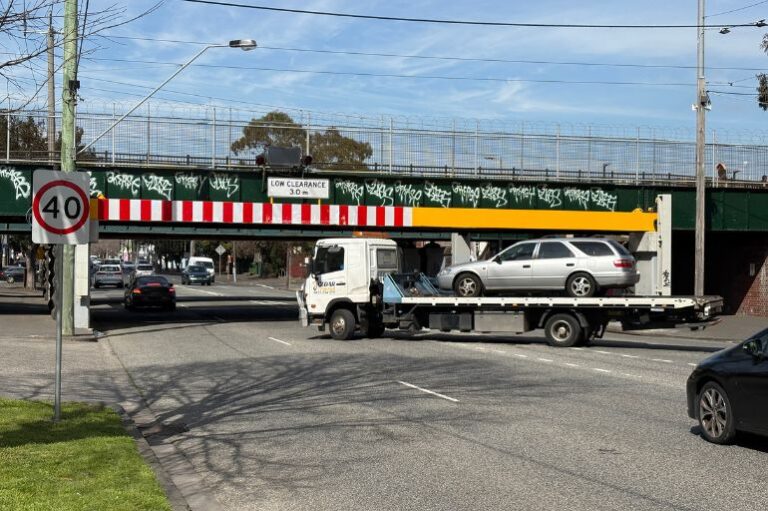
A bridge strike may happen in seconds, but the circumstances that lead to it can develop much earlier in the journey.
That is one of the key fleet-management implications to emerge from HoustonKemp Economists’ report, The economic costs of bridge strikes in Australia, prepared for HERE Technologies and the Australian Logistics Council.
The report estimates approximately 1,220 bridge and protection-beam strikes occurred during FY2025, costing the Australian economy about $101 million.
It also describes bridge strikes as largely preventable.
HoustonKemp identifies driver error, inadequate route planning and unfamiliarity with vehicle height among the factors commonly associated with over-height vehicles colliding with bridges or other overhead structures.
For fleet operators, that shifts the issue from being solely about what the driver does when approaching a bridge to what information, systems and planning are available before and during the trip.
Knowing the vehicle is fundamental
Heavy vehicle fleets can operate combinations with substantially different dimensions.
A driver moving between vehicles, trailers or loads may therefore be operating with a different overall height from one job to the next.
According to the HoustonKemp report, drivers may be unaware of their vehicle’s height or fail to observe warning signs identifying clearance restrictions.
That makes accurate vehicle and load information a basic part of bridge-strike prevention.
The report points to technologies including in-vehicle height warning systems and GPS-based route-planning tools that can alert drivers to height restrictions.
Infrastructure measures also have a role, including warning signage, protection beams and height-detection gantries.
The challenge is ensuring information reaches the driver at a point where an alternative route can still be selected.
Route planning becomes a fleet issue
The scale of Australia’s low-clearance network shows why route choice matters.
HoustonKemp says around 80 per cent of the height-restricted roads identified across New South Wales, Victoria and Queensland are in urban areas, with 69 per cent located in Sydney, Melbourne and Brisbane.
Those are also major freight markets.
The report cites continuing growth in capital-city freight volumes, with Sydney, Melbourne and Brisbane all forecast to carry substantially larger freight tasks by 2040.
That means more interactions between heavy vehicles and constrained urban infrastructure unless operators can better manage the routes taken by different vehicle combinations.
Queensland accounts for 53 per cent of restricted road length identified on the east coast, according to the report, while Victoria has a greater concentration of roads in the lowest clearance bands.
Those differences also mean a route-planning approach that works in one operating environment may not necessarily transfer directly to another.
The operator carries a substantial share of the cost
The business case for prevention extends beyond avoiding infrastructure damage.
HoustonKemp estimates the vehicle operator or driver carries approximately 37 per cent of the total economic cost generated by bridge strikes.
That includes vehicle repairs, lost freight, business interruption, injury-related costs and a portion of bridge repair costs.
For an individual incident, the financial exposure can increase quickly.
The study estimates vehicle-related costs of approximately $11,157 for a protection beam or minor strike, rising to around $24,594 for a moderate incident.
For major incidents, the assumed vehicle repair and replacement cost rises to more than $142,000, while a catastrophic event exceeds $257,000 for the vehicle component alone.
Those figures do not include the broader congestion, infrastructure and disruption costs generated by the incident.
Prevention is broader than driver warnings
HoustonKemp says its estimates can be used to assess potential investment in prevention measures including in-vehicle technology, infrastructure upgrades and driver education.
For fleets, the important point is that bridge-strike prevention can be treated as an operating-system issue rather than simply a driver-behaviour issue.
Accurate vehicle dimensions, appropriate navigation, route approval processes and effective warnings can all contribute to reducing risk before a truck reaches a low-clearance structure.
With bridge strikes forecast to rise to around 1,500 incidents annually by FY2035 without intervention, the report suggests there is an increasing economic incentive for operators, infrastructure owners and governments to find better ways of keeping over-height vehicles away from restricted structures.