

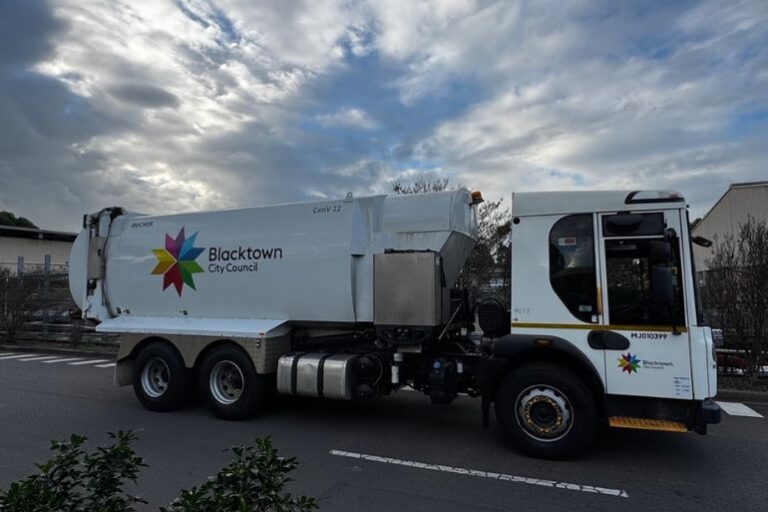
Electrifying passenger vehicles might deliver some quick wins for fleet emissions, but Blacktown City Council is looking further down its fleet list to find where the biggest emissions are actually being produced.
That has put garbage trucks firmly in the spotlight.
Speaking during the Fleet News Group Awards finalists panel at Everything Electric Sydney, Blacktown City Council’s Kris Nair explained why the organisation is examining the electrification of some of its hardest-working heavy vehicles.
Blacktown City Council is a finalist across multiple categories in the Fleet News Group Awards program, including Fleet Sustainability, Fleet Technology and Fleet of the Year.
Its approach to heavy vehicles demonstrates why fleet decarbonisation isn’t necessarily about starting with the easiest vehicles to replace.

Follow the emissions
Nair said Blacktown had previously purchased carbon credits as part of maintaining its carbon-neutral position. However, the council began examining whether investment could instead be directed towards reducing emissions from the fleet itself.
“We looked at the highest emission part of our fleet, which is waste side lifters,” Nair said.
It’s a demanding application.
Nair told the audience that a garbage truck can perform around 1,200 bin lifts a day while operating in a constant stop-start environment. He said fuel consumption for some vehicles can approach 4,000 litres per week.
“And I’ve got 100 of them,” he said.
For a Fleet Manager trying to make a meaningful reduction in fuel consumption and emissions, those numbers quickly focus attention on the heavy fleet.
A difficult duty cycle
Waste collection also demonstrates why heavy-vehicle electrification needs to be considered differently from passenger vehicles.
Vehicles operate early in the morning, repeatedly accelerate and brake and need to navigate increasingly congested suburban streets.
The vehicle also isn’t the only piece of equipment consuming energy. Waste collection requires hydraulic equipment to operate the lifting mechanism throughout the shift.
Blacktown is therefore considering the entire operating system rather than simply replacing a diesel engine with an electric motor.
Electric garbage trucks are coming
The transition has already moved beyond modelling.
“We have already ordered a couple of rear garbage loaders, and we are in the process of possibly trialling a side loader,” Nair said.
Blacktown is also looking at electric power take-off technology for auxiliary equipment. That could produce another benefit for residents: less noise during early-morning waste collections.
Nair pointed out that much of the noise associated with garbage collection doesn’t necessarily come from the truck’s engine.
“The noise is actually not from the actual truck, it’s from the arm,” he said.
Moving that equipment towards an electric PTO provides another opportunity to reduce operational noise.
Look beyond the passenger fleet
The Blacktown example provides a useful challenge for organisations developing fleet emissions strategies.
Passenger vehicles may be easier to electrify because there are more products available and their duty cycles are relatively straightforward. But they may not be where the largest emissions reductions can be achieved.
For fleets operating trucks, plant and specialist equipment, understanding fuel consumption by asset category can reveal a very different decarbonisation priority.
For Blacktown City Council, that analysis is taking electrification all the way to the garbage run.