
Heavy transport operators should avoid treating battery-electric, hydrogen and transitional fuels as competing technologies, according to TR Group Group General Manager NZ and AUS Brendan King.
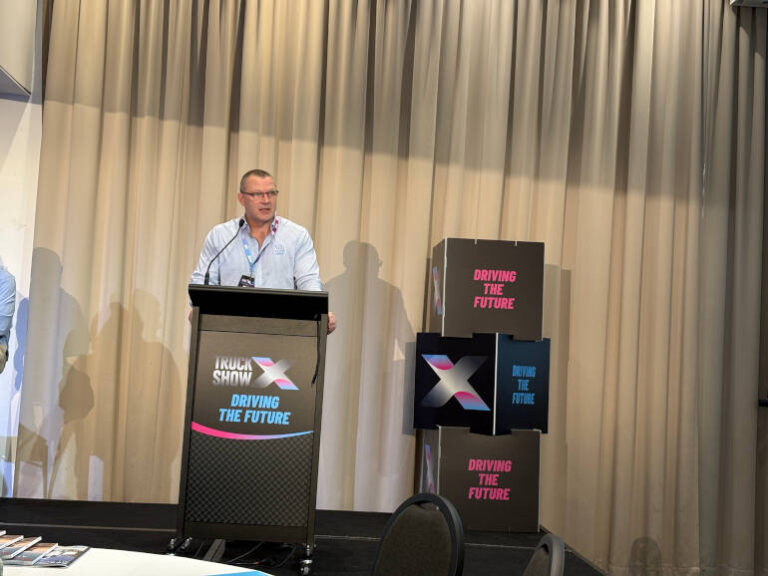
Speaking at TruckShowX, King said the operating demands of freight meant there was unlikely to be one universal pathway to lower emissions.
Heavy trucks work longer hours than passenger vehicles, carry heavier loads and operate under much tighter time constraints. Payload, utilisation, refuelling times and reliability all have a direct impact on fleet productivity.
“Decarbonising heavy transport is not the same problem as decarbonising cars,” King said. “Minutes matter, payload matters, and downtime costs real money.”

King said this helped explain why the uptake of zero-emission trucks had been slower than electric passenger vehicles.
While Australia registered about 71,000 battery-electric passenger vehicles in 2025, King said only about 300 battery-electric trucks were registered during the same period. Most were light trucks, with fewer than 80 weighing more than 17 tonnes.
The difference did not reflect a lack of ambition from the transport industry, he said, but the greater operational difficulty involved in replacing diesel in heavy-duty applications.
“There won’t be a single silver bullet,” King said. “Decarbonising freight will require multiple technologies deployed where they make operational sense.”
That could include battery-electric trucks on predictable metropolitan routes, hydrogen fuel-cell vehicles in high-utilisation operations and hydrogen-diesel systems where fully zero-emission options could not yet meet the task.
TR Group operates a fleet of about 10,000 heavy vehicles across Australia and New Zealand, including more than 100 zero-emission trucks.
As a truck and trailer rental and leasing business, King said TR Group sat between vehicle manufacturers and fleet operators, giving it a practical view of how emerging technologies performed in day-to-day transport operations.
“Our customers are asking for practical solutions, not ideology,” he said. “With the scale of our fleet, TR Group is able to take the new technology risks, so our customers don’t have to.”
King highlighted the performance of a Hyundai XCIENT hydrogen fuel-cell truck introduced by New Zealand Post and TR Group in 2023.
The truck, named BERT — the Big Emission-Reducing Truck — has travelled about 240,000 kilometres on hydrogen while operating regular freight routes.
According to King, it has completed the equivalent of more than 400 standard driver shifts, displaced about 104,000 litres of diesel and avoided approximately 280 tonnes of carbon dioxide emissions.
Importantly, the truck was not restricted to occasional demonstrations or low-utilisation trial work.
“BERT regularly runs double shifts over 24 hours, with a quick 15-minute refill as required,” King said. “It’s real freight under real commercial conditions, not a demo and not a trial running once a week.”
A second example involved Booth’s Logistics transporting 27 containers from a port to a solar farm project using a hydrogen fuel-cell truck supplied by TR Group.
The vehicle travelled about 650 kilometres a day, completing two trips without reducing payload or productivity compared with a conventional diesel truck.
The operator reported saving about 10 tonnes of carbon dioxide emissions across 22 trips.
King said the examples demonstrated the types of applications where hydrogen could offer an advantage.
Battery-electric trucks were performing well on fixed routes with depot charging, particularly in lighter metropolitan applications travelling less than about 300 kilometres a day.
Hydrogen fuel-cell vehicles were better suited to longer-distance, fixed-route and high-utilisation operations where trucks could travel for extended periods and refuel quickly.
Dual-fuel hydrogen-diesel systems could also provide an important transition pathway, displacing between 20 and 40 per cent of diesel in applications that could not yet be serviced by battery-electric or fuel-cell vehicles.
“The key point is this: different freight and operational tasks need different solutions,” King said.
He said battery-electric trucks could be relatively straightforward to introduce at low volumes, but large-scale deployment could create challenges around grid connections, charging infrastructure and electricity supply.
Hydrogen required greater upfront investment, but its economics and operational benefits could improve as vehicle numbers and refuelling demand increased.
Once hydrogen production and refuelling assets were established, King said they could support fuel-cell trucks, dual-fuel vehicles and future hydrogen internal-combustion engines.
He also cautioned against judging future technologies solely on their current costs or capabilities.
Fuel cells were becoming more efficient, batteries were becoming lighter and cheaper, and green hydrogen production was expected to expand.
“What’s not viable today may well be viable tomorrow, which is exactly why flexibility matters,” King said.
In the meantime, operators did not need to wait for a perfect zero-emission solution before reducing fuel consumption and emissions.
Upgrading older trucks, introducing hybrid vehicles, improving tyre management, investing in driver training and lifting overall fleet efficiency could all deliver immediate benefits.
King’s message was that progress would come through matching each technology to the right task, rather than waiting for one solution to replace diesel across every part of the freight industry.
The most successful transition would be one that reduced emissions without compromising the productivity, reliability and utilisation on which transport operators and their customers depended.