
Heavy-vehicle electrification is often framed as a future ambition, but Janus Electric’s experience suggests it is already delivering operational outcomes in specific fleet applications. From port drayage to regional linehaul, the company is seeing growing interest where routes are predictable, utilisation is high and infrastructure can be controlled.
Lex Forsyth, Founder and COO at Janus Electric, says those conditions are now aligning in multiple markets.
“Port operations are the low-hanging fruit. You’ve got predictable routes, limited kilometres and the ability to control charging.”
Expansion beyond Australia
Janus Electric is preparing to enter the North American market, with its first battery-swapping electric prime movers due to begin operation in the United States.
“We shipped our first two battery-swapping kits in December. They arrive in February in the US, and they’ll be the first battery electric swapping tractor units in the North American market.”
Forsyth said port drayage is the natural starting point, particularly around major hubs such as Long Beach and Los Angeles.
“You’ve got around 26,000 trucks a day servicing the Port of Long Beach and LA, operating within about a 150-mile radius. That’s a real sweet spot for electric vehicles.”
He noted that operating conditions in the US could deliver even greater range than Australian deployments.
“We’re forecasting somewhere between 250 and 300 miles of range based on lower tonnages and lower rolling resistance.”
Australian operations building real-world data
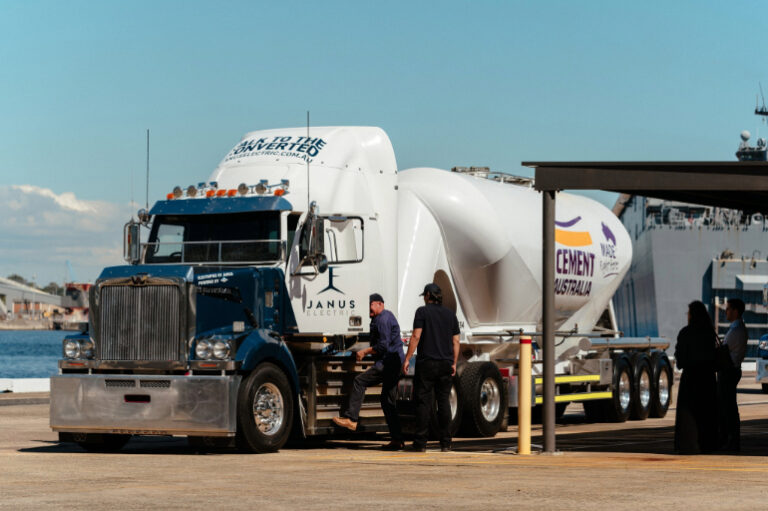
Closer to home, Janus Electric now has trucks operating across a variety of applications, including intermodal freight, cement transport and metropolitan distribution.
“We’ve got seven trucks operating out of the Moorebank intermodal terminal now… Cement Australia trucks in Adelaide and Brighton, and we’ve got trucks operating with Winning doing local pickup right throughout Sydney.”
Forsyth said these applications are generating valuable operational insights, particularly around energy use and maintenance.
“A truck running out of Goulburn is getting about 40 per cent regenerative braking. It’s doing 370 kilometres on a round trip, and they’re barely touching the brakes.”
Rethinking maintenance and asset life
One of the major shifts Forsyth highlighted is how electric trucks change long-term maintenance expectations.
“You don’t look at an electric truck the same way as a diesel asset. You’re not rebuilding engines, alternators, starter motors, fuel pumps — those systems just aren’t there.”
He said regenerative braking is also having a significant impact on wear items.
“The reduction in brake applications is massive. That alone has a huge maintenance saving.”
Janus Electric’s fleet has now accumulated significant kilometres across different duty cycles.
“Our fleet has done just over 600,000 kilometres across logging, cement, containers, linehaul, B-double and single trailer operations.”
Battery swapping and grid constraints
A key differentiator for Janus Electric is its battery-swapping model, which Forsyth says addresses two major constraints: grid capacity and real estate.
“Fast charging a truck is still about 90 minutes. How do you do that at scale, with trailers attached, without massive real estate requirements?”
Battery swapping, he said, changes that equation.
“The truck swaps the battery in four minutes and it’s gone. That fixes the real estate constraint and the grid constraint.”
Forsyth also pointed to broader grid benefits.
“The grid is at full capacity from about 4pm to 9pm. But outside that, it runs at about 20 to 30 per cent efficiency. Battery swapping lets you charge when energy is cheap and stable.”
Battery technology continues to evolve
Forsyth said declining battery costs and new chemistries will further improve the commercial case for electric trucks.
“Batteries are now around $100 a kilowatt hour, and we’ll see them easily sub-$80 in the next few years.”
He highlighted emerging technologies such as sodium-ion and solid-state batteries.
“That takes us from a 650 kilowatt-hour pack to potentially a 1.2 megawatt-hour pack. That’s an instant doubling of range.”
Because Janus Electric’s system uses swappable batteries, fleets are not locked into today’s technology.
“You could be running one of our trucks today, and in five years’ time, still have the same truck but double the range with new battery chemistry.”
Industry pressures beyond technology
While electrification is progressing, Forsyth said the heavy-vehicle industry faces challenges that extend beyond fuel type.
“Manufacturing volumes are down 20 to 25 per cent, margins are tight, and freight volumes have normalised back to pre-COVID levels.”
He also pointed to workforce pressures as a looming issue.
“There’s about 28,000 truck driver vacancies in Australia now, and the average driver age is over 55. By 2030, that could be 75,000 to 80,000 vacancies.”
Looking ahead
From Janus Electric’s perspective, heavy-vehicle electrification is no longer theoretical. Where duty cycles align, the technology is already delivering measurable operational benefits.
“Electrification isn’t new. What’s new is that the technology, the batteries and the data have finally caught up.”
For fleets planning beyond 2026, Forsyth believes the focus should be on matching technology to task — and being ready to adapt as battery and energy systems continue to evolve.
- Scania Powers Up the Slopes
 Scania has signed a long-term agreement with Italian manufacturer Prinoth to expand the use of its industrial battery technology in electric snow groomers, taking electrification into demanding alpine operating conditions. The partnership will support Prinoth’s Husky E-Motion and newly introduced Leitwolf E-Motion, with both machines powered by Scania Core 800 battery packs. For heavy vehicle
 - HERE Connects the Missing Routes for Fire CrewsHERE Technologies and the NSW Rural Fire Service have integrated more than 60,000km of fire trails into an emergency response routing network, helping crews navigate beyond public roads to reach incidents in remote locations. The initiative combines HERE’s road network data with NSW RFS operational mapping to create a unified, routable network incorporating fire trails,
- Scania Expands Digital Tools for Heavy FleetsScania is expanding the technology around its latest truck updates, using connected services, driver coaching and maintenance support to help fleet operators turn vehicle improvements into measurable operating benefits. The company says the Scania Dynamic updates are designed to improve the driver environment, energy efficiency and everyday usability, but the broader fleet proposition increasingly relies
- Minor Bridge Strikes Are Creating a Major BillThe most spectacular bridge strikes attract the headlines, but a new economic study suggests Australia’s biggest bridge-strike bill is being generated by much less dramatic incidents. HoustonKemp Economists estimates protection beam and signage strikes accounted for 79 per cent of Australia’s approximately 1,220 bridge-strike incidents in FY2025. Despite being the lowest severity category used in
- Dash cams are becoming a driver coaching tool, not just an incident recorderDash cams have traditionally been associated with providing evidence after a collision, but Australian fleets are increasingly using video telematics as part of a broader approach to driver safety and risk management. The Geotab Report 2026: Connected Fleets in Australia found 65% of respondents using in-cab video reported improved driver safety. A further 61% reported a reduction