

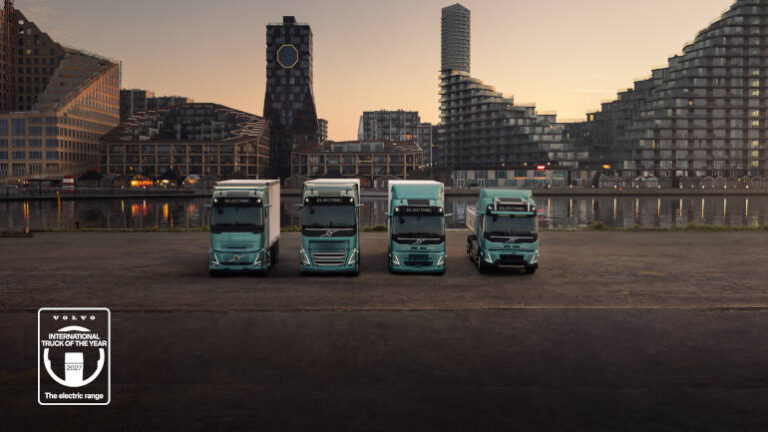
Volvo Trucks’ latest heavy-duty electric range has been named International Truck of the Year 2027, with judges recognising the manufacturer’s move from individual electric truck applications towards a broader portfolio capable of handling regional, long-haul, distribution and vocational work.
The award covers the Volvo FH, FM and FMX Electric, along with the FH Aero Electric, with the new generation offering increased driving range, improved payload capacity and faster charging compared with the previous models.
At the top of the range, the extended-range FH Aero Electric can travel up to a claimed 700 kilometres on a single charge, while the next-generation FH, FM and FMX Electric models offer ranges of up to 470 kilometres depending on configuration and operating conditions.
For fleet operators, the significance is less about the headline range figure and more about the number of applications Volvo is attempting to cover with the same generation of battery-electric technology.
The International Truck of the Year jury highlighted the combination of longer range, different cab and chassis configurations and solutions designed for different transport assignments.
“With its new electric range, Volvo Trucks demonstrates how quickly battery-electric heavy-duty transport is moving from individual applications towards a comprehensive transport solution,” said International Truck of the Year Chairman Florian Engel.
That broader choice is important for fleets assessing electrification because heavy vehicles rarely operate around a single predictable duty cycle. A metropolitan distribution truck, construction vehicle and interstate prime mover can have very different payload, range, charging and body requirements.
Volvo’s strategy is increasingly to provide electric configurations across those applications rather than position battery-electric trucks primarily as an urban delivery solution.
The FH Aero Electric is central to that expansion. New e-axle technology has allowed Volvo to package more battery capacity into the truck, helping deliver the claimed 700km maximum range while retaining payload capacity. Megawatt charging capability is also intended to reduce charging times for long-distance operations.
Series production of the latest generation began this month at Volvo’s Tuve plant in Gothenburg, with production also planned in Ghent, Belgium.
Volvo Trucks President Roger Alm accepted the International Truck of the Year award during IAA Transportation in Hanover.
“I am very proud that we once again get recognised for our electric solutions,” Alm said.
“We see a great demand for our new electric trucks, and the order book is almost full.”
The 2027 award is another indicator of how rapidly electric technology is moving into mainstream heavy-duty truck development. Battery-electric trucks have now won the International Truck of the Year title for four consecutive years, while four of the five vehicles shortlisted for the 2027 award were battery electric.
For Australian fleets, the next question will be how much of this expanded capability becomes available locally and which configurations can deliver workable payload, range and charging outcomes under Australian operating conditions.
The technology is increasingly demonstrating that electric heavy trucks can move beyond depot-based metropolitan work. The challenge for fleets will now be matching the truck, charging infrastructure and operating cycle to identify where that capability produces a practical fleet solution.