

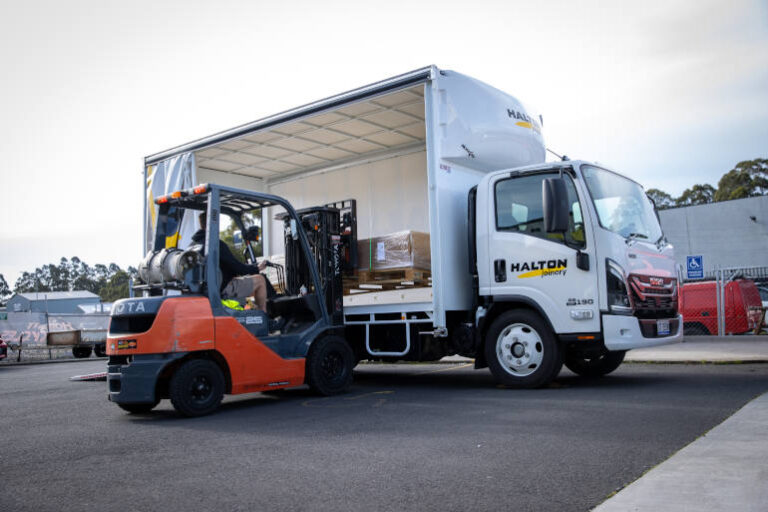
For Hobart-based Halton Joinery, choosing its latest truck was about more than adding carrying capacity. The business wanted to reduce manual handling risks, protect high-value finished products and make deliveries easier to plan.
The family-owned joinery business has added an Isuzu NQR 88-190 fitted with a fully enclosed van body and hydraulic tail-lift, replacing a previous open-tray truck.
Halton Joinery Managing Director Adam Halton said the configuration was shaped by the type of work the company undertakes and the need to move large, carefully finished joinery products safely.
“We wanted a fully enclosed van body with a tailgate loader,” Halton said.
“The tailgate makes loading and unloading much easier for the team, particularly when we’re moving heavy multi-part pieces.
“The biggest driver behind that decision was manual handling and reducing workplace risk for our staff.”
The truck has arrived as Halton Joinery continues to take on increasingly complex residential and commercial projects across Tasmania.
Established in 1999, the business now employs around 25 people and has worked on projects including Hobart International Airport and high-end residential developments. One of its most significant recent projects was the new Phrontisterion library at Mona, where the company manufactured around 280 bespoke bookcases over a project lasting about two and a half years.
Protecting the load
For a business transporting finished cabinetry, weather protection can have a direct impact on productivity and product quality.
Halton said the previous tray truck was suitable in good conditions, but rain and other adverse weather could create problems when moving finished joinery.
“Previously we were carrying products on an open tray,” he said.
“Generally, that works well until the weather turns bad.
“Now we can load jobs the afternoon before, leave everything secure and protected overnight, and head straight to site the following morning.”
That has given the company greater flexibility when scheduling deliveries while reducing the risk of moisture, dust or weather damaging finished products before they reach the customer.
The enclosed body is also larger than the company’s previous setup, giving Halton Joinery more flexibility when transporting large or multi-part items.
Truck specification driven by the job
The NQR 88-190 is powered by Isuzu’s 4HK1-TCC turbo-diesel engine producing 140 kW and 513 Nm.
It is also equipped with safety systems including Advanced Emergency Braking, Electronic Stability Control and Lane Departure Warning.
For Halton, however, the main benefits come from matching the body and loading equipment to the daily work of the business.
The hydraulic tail-lift reduces the amount of manual lifting required when handling heavy joinery components, while the enclosed body provides a controlled space for transporting completed work.
“We want everyone to go home in the same condition they arrived at work,” Halton said.
It is an example of how body configuration can be just as important as the truck itself when businesses are specifying vehicles for specialised applications.
Uptime part of the decision
Halton Joinery has also taken out an Isuzu Service Agreement for the truck, with scheduled maintenance provided through the dealer network.
Halton said the aim was to ensure maintenance remained consistent while giving the business confidence that the vehicle would be available when required.
“For me it was about making sure the truck is maintained properly, stays compliant and is serviced when it should be,” he said.
“That gives us confidence that the vehicle is safe, reliable and ready to work whenever we need it.”
The latest purchase continues a relationship with Isuzu that stretches back to around 2012, when Halton Joinery bought its first new Isuzu Tradepack.
For fleet operators and small businesses carrying fragile or high-value loads, Halton Joinery’s approach highlights the value of looking beyond payload alone.
The combination of an enclosed body, appropriate loading equipment, vehicle safety systems and planned servicing can influence workplace safety, load protection and overall fleet productivity — particularly when the products being transported have already required weeks or months of work before they leave the workshop.