When a fleet needs to leave sealed roads, the instinctive specification can be to jump straight to a 4×4.
But not every council ute replacement, service truck or regional maintenance vehicle needs low-range gearing, high ground clearance and the compromises that can come with a more serious off-road platform.
That is where Isuzu sees a role for the new NMS AWD.
Part of Isuzu’s MY25 N Series range, the NMS sits below the NPS and NQS 4×4 models and is designed for operators that need additional traction on gravel, grass, worksites and slippery surfaces without necessarily requiring a dedicated off-road truck.
For Fleet Managers, that makes the NMS less about conquering extreme terrain and more about matching the vehicle to the actual task.
AWD rather than full 4×4
The NMS replaces the previous NLS and expands the capability of Isuzu’s lighter all-wheel-drive offering.
During Isuzu’s 4×4 drive program, Isuzu Trucks of Product Management & CV Chief Engineer Simon Humphries described the previous model as particularly suitable for organisations such as councils.
“It’s really good for councils and, you know, just not going on serious off-road, but slippery conditions — grass, gravel, etc,” Humphries said.
That distinction matters.
A truck that spends most of its life on sealed roads but occasionally needs to access parks, construction sites, easements, regional properties or unsealed roads may not require the additional capability of a conventional 4×4.
The NMS offers another option.
More payload choice
One of the significant changes with the MY25 model is the expansion of its GVM options. The previous NLS was offered at 4,500kg GVM, allowing it to be driven on a car licence.
The new NMS can still be specified at 4,500kg, but Isuzu now also offers a 6,500kg GVM version for fleets requiring greater payload. Single and crew cab configurations are available.
That gives Fleet Managers more flexibility to match the truck to the job rather than automatically moving into a larger 4×4 platform simply because additional carrying capacity is required.
For councils, utilities and contractors, that could be particularly useful where vehicles need to carry tools, equipment, materials or service bodies while still operating across mixed road conditions.
Two-pedal driving joins the equation
The other major change is transmission choice. The previous NLS was manual only. The new NMS can be fitted with Isuzu’s MYR9 nine-speed dual-clutch transmission, providing a two-pedal configuration, while a five-speed manual remains available.
For multi-driver fleets, that potentially changes the appeal of the AWD truck considerably.
The easier driving experience can make the vehicle accessible to a broader pool of drivers while still providing additional traction when conditions deteriorate.
Humphries was enthusiastic about the change during the technical presentation, noting that the NMS now had a two-pedal solution where the previous model did not.
For organisations operating mixed fleets, reducing the number of vehicles that require drivers comfortable with manual transmissions can also simplify vehicle allocation.
A surprise during the drive program
The NMS also made an impression during the drive program at the Anglesea off-road facility.
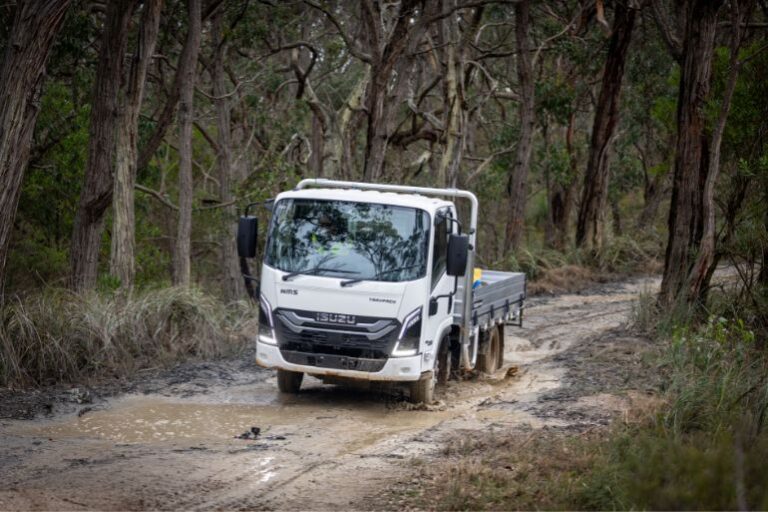
The NMS Traypack had considerably less ground clearance than the larger 4×4 trucks taking part in the program, which was to be expected given its intended role. Yet its ability across the course surprised me. Considering the terrain it went through, it certainly kept up with the other larger trucks.
The NMS was not taken through the water crossing used by the larger 4×4 models because of its different wading capability, highlighting the distinction between AWD assistance and genuine heavy-duty off-road capability.
That difference is important when specifying vehicles. The argument for the NMS is not that it can replace an NPS, NQS or FTS in severe off-road applications. It is that many fleets may never need that level of capability in the first place.
Ready-to-Work broadens the fleet appeal
Isuzu is also integrating the NMS into its Ready-to-Work program. The MY25 range includes NMS-based Traypack, Tipper and Servicepack-X configurations.
That moves the AWD proposition beyond a simple cab-chassis purchase.
A council maintenance team could potentially look at an AWD tipper, while utilities and field-service businesses may see more value in a Servicepack-X configuration.
For Fleet Managers, factory-backed pre-bodied vehicles can also simplify procurement by reducing the amount of separate body specification and coordination required before a vehicle enters service.
Isuzu describes this broader strategy as delivering complete, fit-for-purpose vehicles rather than treating the cab chassis and body as entirely separate purchasing decisions.
Specifying for the job rather than the worst-case scenario
There will always be applications where a genuine 4×4 truck is essential.
Emergency services, mining operations and remote field-service fleets may require low range, greater ground clearance and significantly more demanding off-road capability.
But many fleet vehicles operate in the middle ground. They spend most of their time on sealed roads before being asked to negotiate wet grass, gravel tracks, muddy worksites or poorly maintained access roads.
For those fleets, specifying a dedicated 4×4 for the most extreme scenario imaginable may mean paying for capability that is rarely used.
The NMS offers a different proposition.
It provides all-wheel-drive traction, increased payload options, a two-pedal transmission and access to Isuzu’s Ready-to-Work bodies without pretending to be the most capable off-road truck in the range.
That may make the specification conversation for Fleet Managers fairly straightforward. Before automatically ticking the 4×4 box, ask what terrain the truck will actually encounter.
AWD might be all the fleet really needs.