
The 2025 Technology and Maintenance Conference opened with a strong message from Australian Trucking Association (ATA) Chair Mark Parry, who celebrated the industry’s technical excellence, recognised emerging talent, and called for practical innovation to drive productivity and sustainability.
Addressing delegates at the Melbourne Showgrounds, Parry commended the efforts of industry partners such as Cummins Asia Pacific, whose long-standing support extends beyond sponsorship to directly investing in the next generation of heavy vehicle technicians.
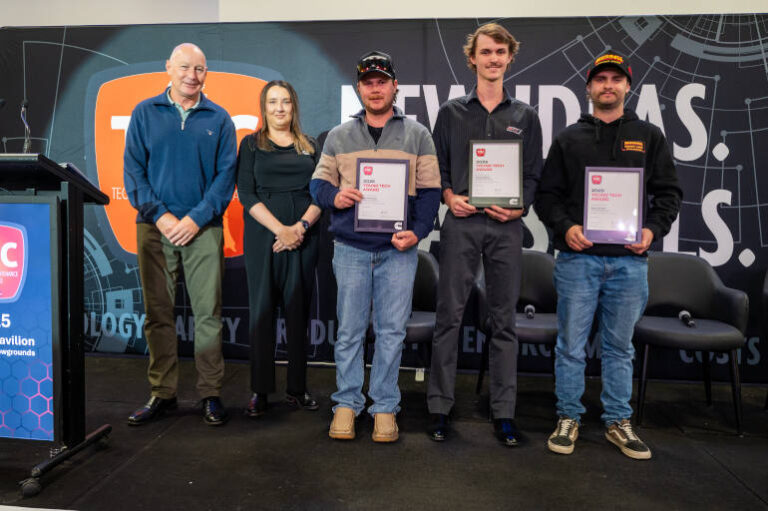
“Cummins’ support for TMC goes far beyond their raffle prize,” Parry said. “Cummins has once again supported three outstanding mechanics to attend the conference through the Cummins Young Tech Awards. In addition to their registrations, the winners have toured two Cummins facilities here in Victoria.”
The Cummins Young Tech Award winners were then welcomed to the stage:
- James Beaven, Murrell Freight Lines, Dapto, NSW
- Thomas Bevan, Mildura Truck Centre, Mildura, VIC
- Jake Wilesmith, Brennan’s Quarries, Tumbarumba, NSW
Parry praised the calibre of regional representation among the winners, noting that such initiatives help strengthen the future capability of the trucking industry workforce.
Focus on Technical Excellence and Industry Guidance
Parry also announced the release of two new Technical Advisory Procedures (TAPs) — providing best-practice guidance that goes beyond the complex language of design rules and in-service regulations.
The updated TAPs cover:
- Low Voltage Electrical Wiring and Lamps, offering detailed advice on truck charging systems, voltage distribution, and LED lamp performance.
- Certified Load Restraint Curtains, outlining certification processes, maintenance requirements, and correct handling of Euro pallets.
“These TAPs are the result of significant work and detail,” Parry said. “They provide the industry with best practice guidance that’s practical and easy to use.”
Printed and digital copies are available through the conference app and the ATA website, with technical sessions dedicated to walking through the updates in detail.
Industry Leadership in Sustainability
Turning to the future, Parry reaffirmed the ATA’s commitment to reducing emissions and contributing to Australia’s 2035 climate targets, which aim for a 62–70% reduction in total emissions compared to 2005 levels.
He praised the Federal Government’s Transport Roadmap for acknowledging the role of higher-productivity freight vehicles as part of the nation’s pathway to net zero.
“People in our industry aren’t waiting for innovation — they’re getting out and doing it,” he said. “But they can find it very frustrating when they’re not supported by regulators and other stakeholders. We’ll continue to prosecute that case on behalf of the industry.”
Parry highlighted ongoing discussions around truck mass and length increases, performance-based standards, and the introduction of an Australian voucher scheme to bridge the cost gap for low-carbon technologies such as hydrogen, electric, and hybrid heavy vehicles.
Setting the Stage for Innovation
The opening session also set the tone for two days of hands-on workshops, technical demonstrations, and forward-looking discussion, with Parry inviting delegates to engage fully with sessions on emissions reduction, technology adoption, and productivity gains.
Before officially commencing the program, Parry introduced Katarina “CJ” Smith, a truck driver and social media creator, who led an engaging discussion with the Team 18 Supercars crew about teamwork, technology, and high-performance operations.
As Parry concluded, the tone for the conference was clear: celebrate skill, embrace innovation, and drive the industry forward with practical solutions that enhance safety, sustainability, and performance across Australia’s trucking sector.
- Waste truck deaths demand a closer look at council transport safety
 Waste collection is one of local government’s most visible services. It also brings heavy vehicles into residential streets, close to pedestrians, driveways and people putting out their bins. Three fatal incidents reported in 2026 highlight the potential consequences when something goes wrong. For council leaders, waste managers and fleet teams, they should prompt a fresh
 - MOTUM Puts Heavy Vehicle Drivers to the TestAustralian simulation technology company MOTUM has completed a heavy vehicle driver training platform that allows operators to practise challenging manoeuvres and hazardous situations in a controlled virtual environment. The platform supports vehicle configurations ranging from rigid trucks and semi-trailers to B-doubles, livestock combinations and oversized vehicles. It also captures performance data, giving instructors a consistent
- Three risks behind more than a third of major truck incidentsInattention, inappropriate speed and inadequate following distance accounted for 38% of major heavy vehicle incidents in 2025, according to new research that gives fleet managers a clear starting point for reviewing their safety priorities. The 2026 National Truck Accident Research Centre (NTARC) Major Incident Investigation Report found human factors contributed to 54.7% of all major incidents analysed.
- Scania G- and R-Series Take Top Safety HonoursScania’s G-series and R-series have achieved five-star ratings in Euro NCAP’s haulage assessment, recording a 96 per cent score for crash avoidance. The results cover four configurations: G-series and R-series 4×2 prime movers and 6×2 rigid trucks. Both model ranges also received Euro NCAP’s City Safe Award, adding to the five-star results previously achieved by
- From incident to fleet redesign: what City of Gold Coast can teach fleet practitionersA serious workplace incident involving a City of Gold Coast tipper truck provides a powerful example of why fleet safety goes well beyond driver behaviour — and why fleet practitioners have an important role in designing, procuring and managing safer vehicles. The lessons from the incident, and the extensive work undertaken by the City of