
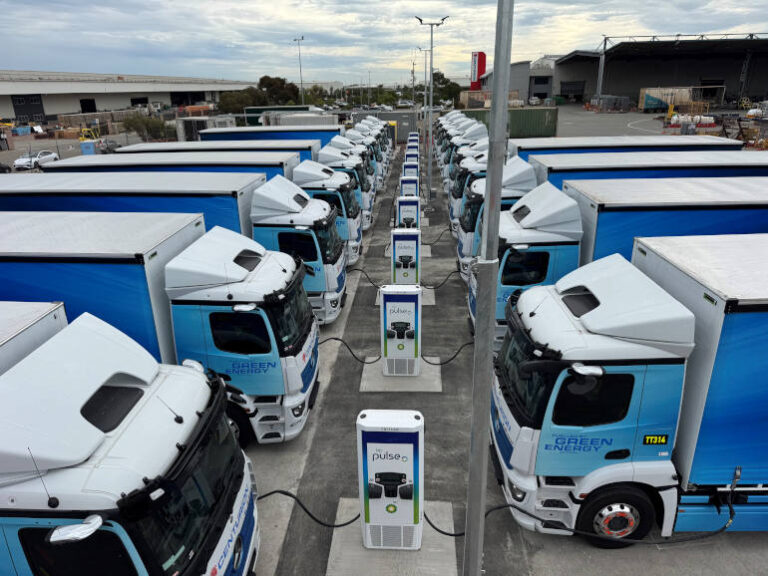
Centurion’s investment in one of Australia’s largest electric truck fleets is now delivering practical lessons for the transport industry, with the company proving that battery-electric trucks can successfully operate in demanding metropolitan freight applications while being powered entirely by off-grid renewable energy.
Speaking with Daimler Truck Australia Pacific’s Head of Vehicle Homologation, Regulatory Affairs and Future Mobility, Romesh Rodrigo, CFC Group’s Group Manager Corporate Affairs & Sustainability Hamish McHaffie outlined how the project has evolved from an ambitious idea into a fully functioning logistics operation.

Electric Trucks Were Ready – The Energy System Wasn’t
McHaffie said the project began after Centurion executives saw an early Mercedes-Benz eActros demonstration in Germany and concluded that battery-electric technology was mature enough for Perth metropolitan freight.
Rather than waiting years for a traditional grid connection, Centurion chose to build its own off-grid energy network.
The company now operates more than 4MW of solar generation, over 10MWh of battery storage and backup generators powered by renewable HVO fuel. The system was designed to guarantee trucks are fully charged and ready every morning while remaining independent of the electricity network.
The approach required Centurion to become both a transport operator and an energy manager, creating one of Australia’s most advanced private charging ecosystems for heavy vehicles.
Charging Designed Around Freight Operations
The company has tailored its charging strategy to match different vehicle applications.
Twenty rigid trucks operate from one depot, completing 10 to 12-hour shifts before charging overnight. Prime movers operating from a second depot return during the afternoon, recharge quickly using solar power and head back out for evening deliveries.
By matching charging schedules to freight movements, Centurion is maximising the use of renewable energy while minimising the size of its battery storage systems.
Drivers Have Embraced the Technology
The biggest surprise has been the positive response from drivers.
According to McHaffie, operators consistently praise the trucks for their quiet operation and instant performance compared with diesel vehicles. The electric fleet has also helped attract new employees after Centurion brought what was previously subcontracted metropolitan work in-house.
Like any new technology, the rollout has included some practical lessons. Early charging issues caused by connectors not being fully engaged were solved with a simple overnight inspection process, ensuring every truck is ready before drivers arrive.
The Next Challenge Is Infrastructure
With the fleet now operating successfully, McHaffie believes future growth depends less on vehicle technology and more on regulation and charging infrastructure.
He pointed to front axle weight rules and the development of heavy vehicle charging corridors as the next priorities for governments.
Western Australia has already begun investigating what a dedicated heavy transport charging network could look like, and Centurion is actively involved in discussions about how its renewable energy assets could support longer-distance electric freight operations.
Measuring Progress
While comparing emissions with previous subcontracted operations is difficult, Centurion now closely tracks the activity and emissions performance of its electric fleet.
The trucks collect freight throughout Perth before transferring loads onto long-haul vehicles servicing regional and mining customers, allowing the company to reduce emissions across an important part of its supply chain.
The discussion demonstrated that Centurion’s electric truck program has moved beyond proving that battery-electric freight is possible. The focus is now on refining operations, expanding infrastructure and building a practical model that can support wider adoption across Australia’s transport industry.