For fleets looking to reduce fuel use, tyre costs and emissions, the next improvement may not require a new powertrain or major capital investment.
A case study presented by Big Wheels Truck Alignment and sustainability consultancy Impact HQ Australia at TruckShowX has highlighted how precision wheel alignment and disciplined tyre management can deliver measurable operating savings in both urban delivery and linehaul applications.

The results point to a simple reality for fleet operators: when wheels, axles and trailers are not tracking correctly, the vehicle is effectively dragging tyres down the road.
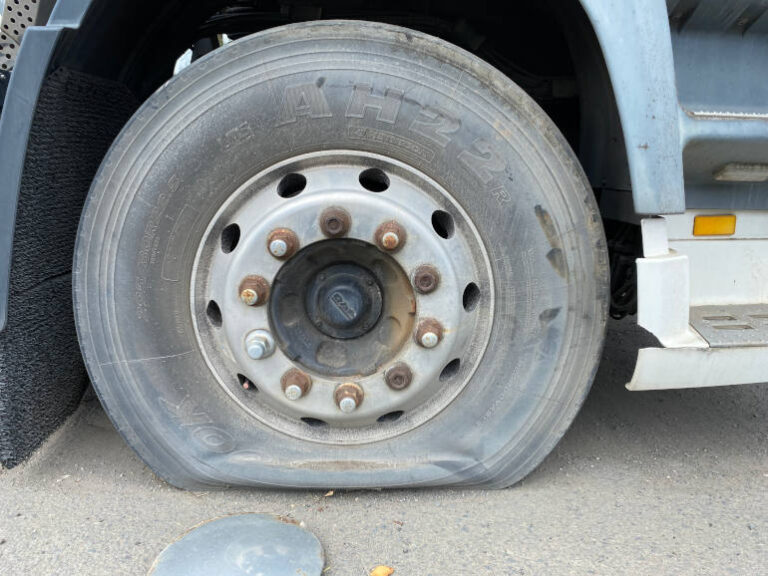
That increases rolling resistance, accelerates tyre wear and uses more diesel.
A 7.6% fuel reduction in urban delivery work
The first case study involved four light rigid delivery trucks operating in stop-start Melbourne metropolitan work.
Big Wheels Truck Alignment measured fuel use over 8,000 kilometres before alignment work, then compared it with another 8,000 kilometres after the vehicles had been set up for their specific operating environment.
The reported result was a 7.6% reduction in fuel consumption.
Lachlan Van de Haar, CEO of Big Wheels Truck Alignment, said the approach was not simply a matter of straightening the steering wheels or setting toe and moving on.
“We didn’t just toe and forget,” he said. “We precision aligned them. Camber, caster, toe and thrust angle alignment [were adjusted] to suit their application.”
For metro delivery vehicles, that means considering the reality of their work: frequent turns, tight access points, cul-de-sacs, braking events and repeated low-speed manoeuvring.
The case study estimated combined annual diesel and tyre savings of about $3,057 per truck, based on diesel costing $1.76 per litre at the time of the analysis.
The fleet also reportedly increased steer-tyre life from about 26,000 kilometres to between 30,000 and 40,000 kilometres.
Alignment affects more than tyres
Poor alignment is often treated as a tyre-wear issue. But the operational impact is broader.
When tyres scrub across the road surface instead of rolling in the intended direction, the engine must work harder to maintain speed. That additional resistance translates directly into fuel consumption.
“Poor alignment introduces drag into a vehicle,” Van de Haar said. “If you’re seeing excessive tyre wear, something is dragging, which is also going to cause an inefficiency.”
For fleets, that creates a chain of costs:
- more fuel consumed per kilometre;
- tyres replaced earlier;
- more workshop interventions;
- increased waste from prematurely discarded tyres; and
- a higher emissions profile for every delivery or trip.
The driver feedback in the urban trial also added another dimension. All participating drivers reportedly identified improvements after alignment, including greater comfort, reduced vibration and noise, better braking feel and more confidence in the vehicle at speed.
One driver described the difference simply: “The truck just glides. I finish my shift feeling less tired, less stressed and more confident about driving on the road.”
Bigger gains in linehaul work
The second case study focused on a Melbourne-to-Sydney refrigerated linehaul operation involving a three-axle prime mover and three-axle refrigerated trailer.
In this application, Big Wheels Truck Alignment adjusted the prime mover’s camber, caster and toe settings, while also correcting the drive-axle thrust angle.
The trailer was treated as part of the same system, with axle squareness and toe adjusted across all three trailer axles.
That whole-of-combination approach delivered a reported 10.1% reduction in fuel use and associated emissions. The study estimated fuel savings of 7.3 litres per 100 kilometres.
For a high-frequency linehaul operation, that is a significant number. Even modest improvements in litres per 100 kilometres compound quickly when vehicles are travelling hundreds of thousands of kilometres each year.
Tyre management belongs in the fuel strategy
The presentation also reinforced the importance of tyre pressures.
Correct pressure management, combined with alignment, helps reduce rolling resistance while protecting tyre life and maintaining predictable handling. Underinflation can increase heat and resistance, while overinflation can compromise the tyre’s contact patch, ride quality and wear characteristics.
For Fleet Managers, the message is that tyres should not sit only within the maintenance budget. They should be part of the fleet fuel strategy, safety strategy and emissions-reduction plan.
Dr Richa Vijayraj, founder of Impact HQ Australia, said many transport businesses assume sustainability requires major investment in electric vehicles or alternative fuels. But lower-cost operational improvements can deliver an immediate result.
“When you talk about sustainability, it’s not really about making those big investments,” she said. “It could be idle-time reduction, route optimisation, scheduling, optimising your schedules or loads. It could be anything. Finding those low-hanging fruits within your operations.”
A practical tender and customer advantage
The financial case is clear, but there is also an increasing customer and procurement benefit.
As larger businesses begin to collect more Scope 3 emissions data from their supply chains, transport providers will increasingly be asked to demonstrate how they are reducing emissions and improving efficiency.
A fleet that can show measured fuel reductions, longer tyre life and lower waste has a stronger story for customer reviews, sustainability questionnaires and tender submissions.
The lesson from the case studies is straightforward: fleet decarbonisation does not always start with buying new vehicles.
Sometimes it starts with ensuring the existing trucks and trailers are rolling exactly as they should.