




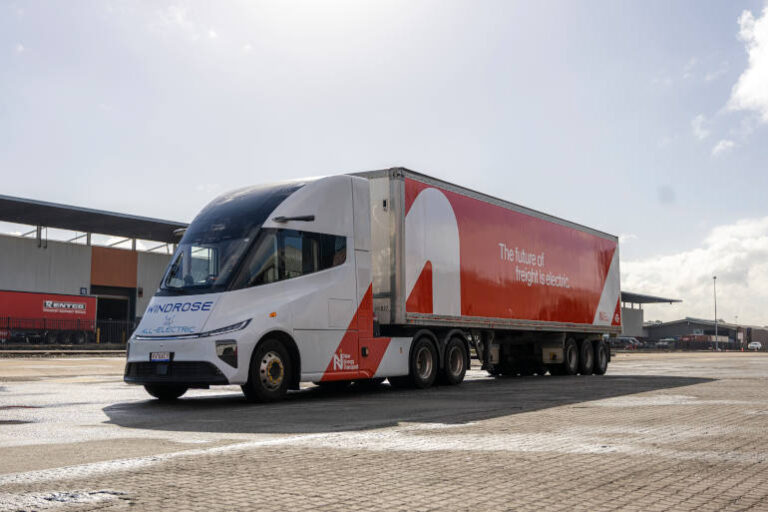
New Energy Transport has secured new funding to fast-track the deployment of electric road freight in Australia, with the company planning to have its first electric trucks operational before the end of 2026.
The electric road freight company has unlocked an initial $5 million in funding through an equity raise backed by institutional investors Jekara Group, leading family offices and high-net-worth investors. The raise was facilitated by net zero advisory firm Pollination.

The funding will support NET’s rapid deployment plan, which includes 20 new electric prime movers and six mobile ultra-fast charging units positioned on heavy road freight corridors throughout NSW.
For fleet and freight operators, the announcement is significant because it tackles one of the biggest barriers to heavy vehicle electrification: charging infrastructure. Rather than waiting for large fixed depots to be completed, NET is using modular and mobile charging units that can be operational within 16 weeks.
Daniel Bleakley, Co-CEO of New Energy Transport, said the investment would allow the company to respond to growing demand from major transport buyers.
“We’ve seen a surge in demand from some of Australia’s largest transport buyers and this backing means we can meet that demand by providing reliable electric road freight in Australia before the end of the year,” said Bleakley.
The mobile charging units are not fixed to the ground. They sit on a frame, plug into the grid and can be redeployed as freight corridors change or expand. This gives NET flexibility to service new corridors, including regional and rural routes.
The rapid deployment plan is designed to build momentum ahead of NET’s larger infrastructure project at Wilton in NSW, where the company is planning Australia’s largest heavy electric trucking depot.
The Wilton depot has been selected under the Federal Government’s Investor Front Door program as a project of national significance. It is expected to be operational in late 2027, with initial capacity for 50 trucks and room to expand to 200 over time.
The location is intended to anchor freight movements between Sydney, Wollongong, Newcastle and Canberra. NET is also progressing plans for a wider network of electric road freight depots connecting Adelaide, Melbourne, Sydney, Canberra and Brisbane by 2031.
The company says the first 20 electric trucks will be capable of delivering 10,000 kilometres of fully loaded line haul freight capacity each day and saving 2.5 million litres of diesel per year.
NET’s Co-CEO Fredrik Pehrsson said the company had already demonstrated the potential of electric freight, including an end-to-end electric road freight delivery from Sydney to Canberra on a single charge.
“The bottleneck for electrifying road freight isn’t the technology; it’s the charging infrastructure. NET’s additional rapid deployment plan addresses this challenge head on,” said Pehrsson.
He said the business case for electric heavy road freight was becoming clearer as diesel price volatility continued to create uncertainty for freight operators and customers.
“With further diesel price shocks anticipated, the business case for electric heavy road freight has never been clearer. Stable, predictable and lower freight costs are a genuine competitive advantage,” said Pehrsson.
The modular charging model also has potential applications beyond metropolitan freight corridors. NET has identified agricultural freight routes, including Yass and Griffith in NSW, as possible future locations for mobile charging units.
Kara Frederick, Managing Partner and Founder at Jekara Group, said electric freight could improve productivity and deliver broader economic benefits.
“The potential for electric road freight to boost productivity and have a deflationary impact on Australia’s economy is significant,” said Frederick.
For Australian fleets, NET’s model is another sign that heavy vehicle electrification is moving from trials and announcements into commercial operations. The ability to deploy charging quickly, gather operating data and then scale into larger permanent depots could become an important pathway for transport operators trying to manage the transition from diesel to electric trucks.
While electric passenger vehicles have attracted much of the attention in recent years, the next stage of fleet decarbonisation will need to address freight. NET’s announcement shows how private capital, modular infrastructure and customer demand are starting to align around electric heavy transport.