

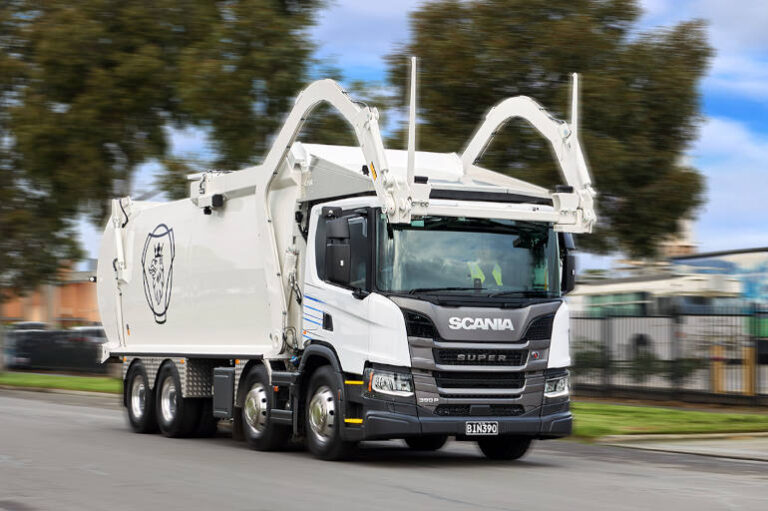
Scania Australia will showcase its Super 11 heavy-duty rigid trucks at Waste Expo Australia 2026, targeting waste operators with a combination of lower tare weight, improved fuel efficiency and safety systems suited to urban collection work.
The range includes 8×4 front-lift and 6×4 hook-lift configurations, with low-entry P-cabs designed to support drivers working in demanding, stop-start environments.
For council and commercial waste fleets, the focus is on improving collection productivity while managing fuel costs, payload requirements and the risks associated with operating heavy vehicles around other road users.
Scania Australia Director of Truck Sales Benjamin Nye said the configurations bring together driver comfort, manoeuvrability and strong low-speed performance.
“The Scania 8×4 front-lift and 6×4 hook-lift waste configurations combine premium driver comfort, excellent manoeuvrability, strong low-rpm torque and payload efficiency to maximise collection productivity while reducing operating costs,” he said.
Fuel savings and payload potential
The Super 11 five-cylinder engine is available with outputs of 350 hp, 390 hp and 430 hp, delivering 1,800 Nm, 2,000 Nm and 2,200 Nm respectively.
Scania claims the new powertrain options deliver a seven per cent real-world reduction in fuel consumption, although individual fleet results will depend on operating conditions and vehicle configuration.
“Given the ongoing volatility in fuel costs, the new Scania Super 11 powertrain options deliver a 7% real world reduction in fuel burn, leading directly to savings on the bottom line for all operators,” Nye said.
The engines meet Euro 6e emissions requirements and can operate on hydrotreated vegetable oil (HVO). The 390 hp and 430 hp versions can also use B100 biodiesel.
Scania says the lighter five-cylinder powertrain creates opportunities to increase payload capacity, while front axle ratings support the demands of heavier front-loader bodies.
“Our lightweight five-cylinder powertrain can provide higher payload capacity, with excellent front axle ratings well-suited to the heavier front-loader bodies without compromising legal axle loads,” Nye said.
For fleet buyers, this makes the completed vehicle specification important: body weight, axle loading and collection requirements will determine how much of that payload potential can be used.
Safety for urban collection routes
The Super 11 range includes a driver airbag and side curtain rollover airbags above both doors as standard.
Its driver assistance package includes Advanced Emergency Braking, Blind Spot Warning, Driver Attention Support, reverse detection and front and side Vulnerable Road User Collision Warning. Lane assistance and adaptive cruise control systems are also included.
These features are particularly relevant to waste fleets operating in streets and commercial precincts where trucks regularly interact with pedestrians, cyclists and other vehicles.
The low-entry P-cab is designed to make access easier, while a deep windscreen supports visibility when manoeuvring and aligning front-lift forks with bins.
Scania says its steering geometry also helps drivers negotiate metropolitan and industrial environments, with easier bin approaches and reduced tyre scrub compared with some competitors.
Supporting drivers and vehicle uptime
Inside the cab, Scania has focused on driving ergonomics and reduced noise to support drivers during repetitive collection work.
All-round air suspension is intended to improve ride comfort and stability, while helping protect the body and load.
The powertrain’s low-rev, high-torque characteristics are also suited to frequent stopping and starting, including operations requiring hydraulic power take-off equipment. Factory-engineered bodybuilder interfaces support integration with front-loader and hook-lift bodies.
Beyond the vehicle, Scania offers remote diagnostics, maintenance plans and support through its Australian branch and authorised dealer network.
Nye said finance, insurance and repair and maintenance contracts could be tailored to help operators manage ownership costs across the life of the asset.
For waste fleet managers, the overall proposition extends beyond fuel consumption to include driver access, usable payload, body integration and maintenance predictability.
Waste Expo Australia takes place on 28–29 October at the Melbourne Convention and Exhibition Centre.