

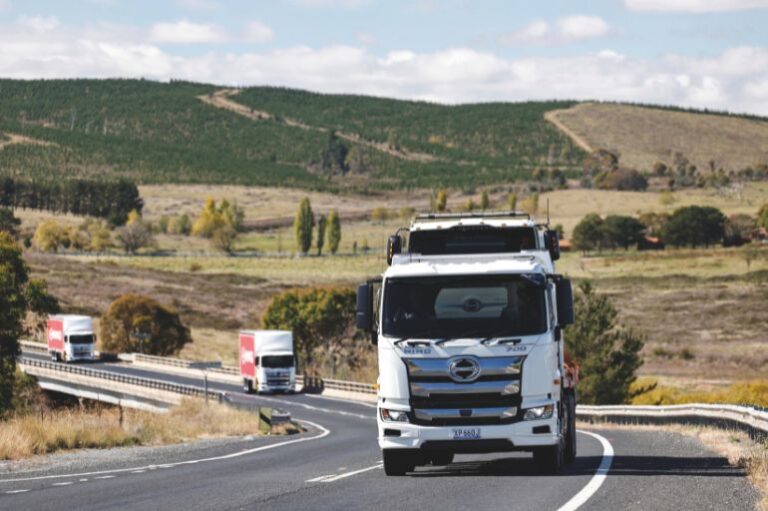
Australia’s truck market is facing another difficult year, with weaker business confidence and delayed purchasing decisions weighing on sales. But Hino Australia believes growing freight demand and ageing fleets will eventually bring buyers back, even if the timing of a recovery remains uncertain.
Speaking at an exclusive media briefing during the launch and drive of the Euro 6 Hino 300 Series, Hino Australia President and CEO Richard Emery said the company was preparing for improved product availability in 2027 while managing a challenging finish to 2026.
“It would be fair to say that 2026 has not gone to plan, with a combination of global events, higher fuel prices, consumer confidence and interest rates creating a more challenging environment than we anticipated at the beginning of the year,” said Emery.

Truck sales under pressure across the market
At the briefing, Emery put the overall truck market decline at approximately 15 per cent year to date, following a fall of around 16 per cent in 2025.
His assessment highlighted different conditions across the market. Light-duty sales were down around 18 per cent, medium-duty around 10 per cent, while the heavy-duty segment was down a few per cent.
Within heavy-duty, however, heavy rigid trucks were proving more resilient than prime movers. Emery said the heavy rigid segment was showing a slight increase, while conditions for linehaul operators were more difficult.
Smaller businesses were particularly sensitive to economic uncertainty. Larger corporate customers continued to buy, but were scrutinising purchases and the commercial terms supporting each order.
Those figures also need context. Emery acknowledged that sales from brands outside industry reporting were not captured in the headline numbers. Supply constraints affecting established manufacturers further complicated the distinction between weaker demand and an inability to deliver particular trucks.
Hino’s 2026 result reflects supply gaps as well as demand
For Hino, the downturn has coincided with significant gaps in its product offering.
Emery said 300 Series volumes were around 15 per cent below the company’s plan for 2026. Alongside softer demand, the range had been affected by a production interruption of more than nine months during its transition to Euro 6.
Dealers continued to hold 300 Series stock, but availability did not always match the models customers wanted. Standard Cab trucks and some Built to Go products, including tippers, were among the affected variants.
The absence of fresh 500 Series supply has created a larger gap in Hino’s medium-duty business.
Together, those constraints meant Hino was unlikely to match its 2025 sales volume, although Emery said the result would be close. Despite the challenges, the company said it had maintained its position as Australia’s number two truck brand.
700 Series delivers a stronger result
The standout for Hino has been its heavy-duty 700 Series, supported by an expanded model range and demand for heavy rigid applications.
“The 700 Series is in a purple patch at the moment – since June, we have averaged around 100 retail sales per month, which is a record,” said Emery.
At the briefing, he reported approximately 600 sales year to date and said the company was targeting around 1,000 for the full year.
That remained an ambition rather than a completed result. Emery said the order bank supported the target, with the final outcome dependent on deliveries before the end of December.
The stronger heavy-duty performance has helped offset the missing medium-duty business, while broadening Hino’s customer base across more applications.
Product availability improves in 2027
Hino’s plans for 2027 centre on rebuilding its product coverage.
Euro 6 300 Series trucks are reaching dealerships, with the full line-up expected by mid-2027, including new High Horsepower models and fresh Crew Cab supply. Further details are expected at the Brisbane Truck Show in May.
The Euro 6 500 Series is also due to return to the Australian market in 2027.
“The 500 Series is our heartland, and we have been a major player in this segment for many years,” said Emery.
“We know there is strong customer demand for the product, and we believe the 500 Series line-up will give us the opportunity to return to the market strongly in 2027.”
Emery acknowledged that some customers had purchased competing products during the supply gap. Others had adjusted replacement schedules or indicated they intended to return when Hino supply resumed.
Recovery depends on confidence returning
Hino’s outlook rests on the need to move more freight and replace trucks being retained longer than operators originally intended.
Emery said the strong sales years around COVID had not necessarily delivered a corresponding reduction in fleet age. Operators often added new trucks while retaining existing vehicles to meet demand.
“The freight task continues to increase, so we will need more trucks,” he said.
However, that underlying requirement does not establish when operators will commit to purchases.
“Whether that occurs in 2027 or 2028 is difficult to predict, but the fundamentals remain positive,” said Emery.
For fleet managers, improving availability across Hino’s range creates more options for replacement planning in 2027. The practical task is to confirm delivery timing for the required specification, coordinate bodybuilder capacity and assess the cost and operational implications of retaining existing trucks.
Hino is preparing for a stronger year through a broader product offering. A wider market recovery will also require the confidence to turn deferred fleet requirements into orders.