

For emergency services, vehicle selection is rarely about choosing a standard truck and adding a body.
Payload, off-road capability, driver accessibility, safety systems, manoeuvrability and aftersales support all become critical when the vehicle may be expected to respond to fires, natural disasters or other emergencies.
That is the message behind Isuzu Australia’s display at AFAC26 in Melbourne, where the company will showcase the new NQS 80-175 4×4 alongside specialist power generation and pumping equipment.
The display provides an insight into the increasingly complex procurement decisions facing emergency service fleet managers.
Built for a diverse driver pool
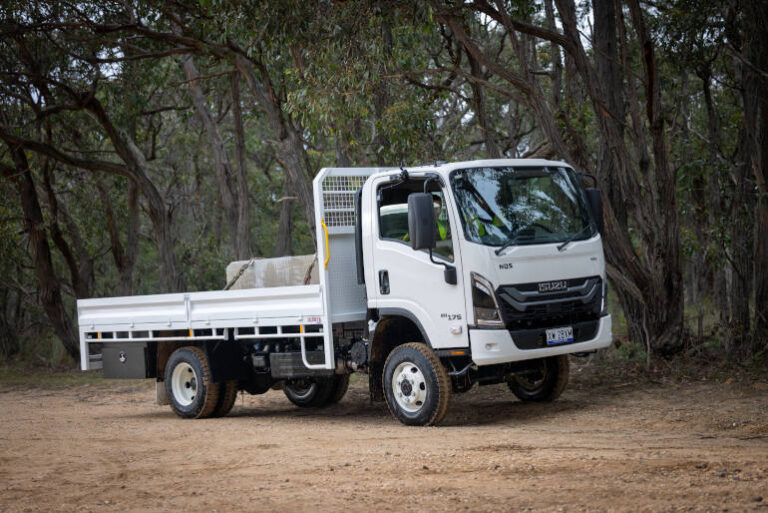
At the centre of Isuzu’s AFAC26 stand will be two versions of the NQS 80-175 4×4 — a crew cab and a single cab.
The truck has an 8,000kg GVM and uses Isuzu’s 4JZ1-TCH four-cylinder engine producing 129kW and 460Nm, paired with a nine-speed MYR-9R dual-clutch transmission.
Importantly for emergency service fleets, the transmission provides both fully automatic and clutchless manual operation.
That becomes particularly relevant where vehicles may be operated by a broad mix of professional and volunteer drivers.
Isuzu Australia Head of Sales Craig White said ease of operation had been an important consideration.
“This ease of use and the familiarity of the Isuzu approach to vehicle design and operation means that the vehicle is simple to use and approachable for a diverse driver group,” White said.
It is a consideration that extends beyond emergency services. Fleet vehicles increasingly need to be accessible to drivers who may spend relatively little time behind the wheel of a particular truck.
Getting equipment and people where they are needed
The NQS uses a part-time four-wheel-drive system with direct high range and a 2.14:1 low range, giving it the ability to operate across the difficult terrain regularly encountered by fire and rescue crews.
The crew cab provides seating for up to seven people, including a four-person rear bench, while the single cab offers a lower tare weight where payload capacity is more important.
Both models have a 3,395mm wheelbase and a 14-metre kerb-to-kerb turning circle, assisting manoeuvrability in regional towns, restricted access areas and off-road environments.
“The new NQS brings together the right payload-to-driveline mix for local fire applications,” White said.
“It has serious off-road ability and the right mix of features and specifications our emergency fleets need.”
Safety specification continues to grow
Emergency fleet vehicles need to protect their occupants while travelling to an incident as well as when operating at the scene.
The new NQS includes Adaptive Cruise Control, Advanced Emergency Braking, Electronic Stability Control, Lane Departure Warning, an Attention Alert System and Traffic Sign Recognition.
There are also driver and front passenger airbags, seatbelt pretensioners and an ECE-R29 cab incorporating side anti-intrusion beams.
The inclusion of these systems reflects the broader change occurring across commercial fleets, where active safety technology is becoming an increasingly important part of vehicle specification rather than an optional extra.
Fleet capability doesn’t stop with the vehicle
Isuzu’s AFAC display will also extend beyond trucks.
The company will show its new Isuzu Power Solutions GS012-ETT generator, a compact three-phase unit producing 12.1kVA of prime output and 13.3kVA of standby output.
It can operate for at least 10.5 hours from its 40-litre fuel tank.
The generator is intended for emergency response, staging and recovery applications where independent power may be needed for communications, lighting, refrigeration, pumping and other essential equipment.
“Reliable power remains essential well beyond the initial response, particularly when disaster or weather outages affect communications, lighting, refrigeration, pumping and recovery facilities,” White said.
Isuzu will also display a 3CA1PZ01 four-cycle diesel engine configured for truck-mounted pumping duties.
Support is part of the procurement decision
Emergency vehicles need to remain operational for long periods, often well beyond the normal service life of passenger fleet vehicles.
Isuzu says its product and technical specialists will be available during the exhibition to discuss body integration, vehicle selection, power requirements and aftersales support.
Isuzu Service Technical Manager for NSW and the ACT, Jeff Berry, will also present a session examining how aftersales capability supports frontline operations.
White said emergency service applications place particularly high expectations on vehicle suppliers.
“There’s no better example of the need to perform than when your product is specified in emergency service fleets — the requirement to deliver on the promise is non-negotiable,” he said.
For fleet managers, that may be the most important takeaway.
The specification determines whether a vehicle can perform the task. But for specialised fleets, the availability of engineering expertise, body integration support, parts and servicing can be just as important in determining whether the asset delivers throughout its working life.
Isuzu Australia will exhibit at Stand 238 during AFAC26, which runs from 18 to 21 August 2026 at the Melbourne Convention and Exhibition Centre.